

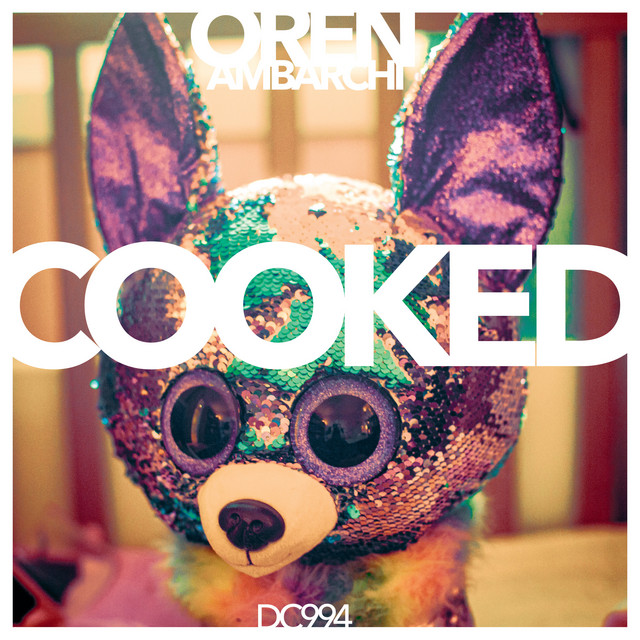
Oren Ambarchi | Cooked [Drag City]
Experimental / Avant-Jazz / Electroacoustic / Psychedelic Jazz | 2026
Oren Ambarchi has spent decades investigating the possibilities of electric guitar, improvisation and studio composition. On "Cooked", released September 25, 2026 through Drag City, the Australian musician brings these interests together across two extended instrumental compositions. The album runs for approximately 43 minutes and involves twelve collaborators working with acoustic instruments, electronic synthesis and processed sound. Its greatest achievement is the extraordinary control Ambarchi exercises over this considerable musical activity. Each contribution affects the arrangement, and seemingly minor changes in rhythm or instrumentation can completely alter the character of a passage.
The approach continues the collaborative studio construction of 2022's "Shebang", although "Cooked" gives greater prominence to unstable electronic timbres and irregular changes in momentum. Ambarchi's guitar frequently occupies a supporting position. Piano, double bass, percussion and synthesized sounds establish much of the musical character, allowing the guitar to enter at carefully chosen moments. The compositions develop patiently, with extended passages of restrained playing interrupted by increasingly complex rhythmic activity.
"Hidden Tableau" opens with Eiko Ishibashi's delicate piano figures, whose repeated notes establish a measured harmonic foundation. Konrad Sprenger introduces synthesized vocal sounds almost immediately. Their strained, resonant tones are particularly unsettling because their articulation suggests human expression without producing intelligible language. The electronic processing creates irregular fluctuations in pitch and timbre, while Ishibashi maintains a remarkably composed performance. Johan Berthling's double bass and Jim O'Rourke's synthesizer gradually increase the harmonic density, allowing the unusual vocal material to remain prominent throughout the opening section.
The development of "Hidden Tableau" is particularly impressive once Joe Talia's drums become prominent. His playing introduces a loose, swinging momentum, supported by increasingly active bass figures and sustained electronic harmonies. The synthesized vocal sounds gradually lose their initial prominence as the instrumental arrangement becomes denser. Ambarchi contributes bright, rapidly articulated guitar figures, and the final section develops considerable rhythmic intensity through overlapping electronic sequences and instrumental patterns. The abrupt ending preserves the tension generated during the preceding minutes. At 21 minutes and 41 seconds, the composition sustains attention through its changing relationships between the musicians, although the extended opening requires patience before its rhythmic direction becomes apparent.
"Sleight of Hand" begins with Ambarchi's electric 12-string guitar playing fluid, carefully articulated phrases. Berthling's double bass establishes a restrained pulse, while Andreas Werliin supplies understated percussion. The opening minutes contain some of the album's most accessible playing. The guitar has a clear melodic character, and the rhythm section allows considerable flexibility around the underlying tempo. James Rushford contributes piano, celeste and portative organ, introducing additional harmonic detail without overwhelming the guitar. Michiko Ogawa's shō adds sustained tones that gradually become more prominent within the arrangement.
The central section of "Sleight of Hand" contains some of the record's most adventurous electronic playing. Marcus Pal introduces rapidly changing digital synthesis, with complex melodic figures and sharply articulated timbres interrupting the established instrumental patterns. Will Guthrie's contributions on drums and gamelan increase the rhythmic density. The ensemble moves through passages of considerable intensity, yet Berthling's bass continues to provide a recognizable pulse. The relationship between acoustic percussion and electronically generated sound is especially effective here. Ambarchi allows the electronic material to become temporarily dominant before the arrangement gradually settles into another rhythmic configuration.
The closing minutes provide one of the album's most distinctive passages. Fredrik Rasten's guitar contributes delicate additional figures, while Isak Hedtjärn introduces melodic whistling. The whistles are surprisingly expressive, with clear changes in register and phrasing that complement the gentler instrumental accompaniment. A steady rhythmic pattern returns beneath the ensemble, and the music gradually becomes calmer before fading out. This extended conclusion demonstrates Ambarchi's ability to maintain musical continuity while substantially changing the instrumentation and overall dynamics.
Much of "Cooked" was assembled through recording sessions conducted across several countries between 2022 and 2025, with Joe Talia and Ambarchi responsible for the final mixing. That process is fundamental to the album's character. Individual performances retain their distinctive timing and articulation, but their placement produces deliberate changes in tension and musical density. The transitions are rarely predictable, particularly when electronically processed sounds interrupt the acoustic arrangements. The production maintains enough separation between instruments to make even the busiest sections worth examining closely.
There are moments when the abundance of musical information becomes exhausting. The central electronic passages of "Sleight of Hand" occasionally sustain their intensity beyond the point of maximum impact, and the deliberate pacing of "Hidden Tableau" can challenge listeners looking for immediate rhythmic development. These reservations are relatively minor within a record whose extended structures reward repeated listening. Ambarchi consistently finds interesting relationships between contrasting instrumental techniques, and the musicians contribute performances that remain individually recognizable throughout the complex arrangements.
"Cooked" is an accomplished addition to Ambarchi's extensive discography. Its combination of experimental jazz, electroacoustic composition and detailed studio editing produces two substantial pieces with distinct musical identities. The opening composition emphasizes unstable electronic timbres and gradually increasing rhythmic activity, while the second develops from fluid guitar improvisation into dense synthesis and an unusually gentle conclusion. Ambarchi's compositional judgment holds these contrasting developments together, producing an album of considerable depth whose strongest passages demonstrate genuine imagination and impressive ensemble control.
Rating: [4/5]