

Collection review
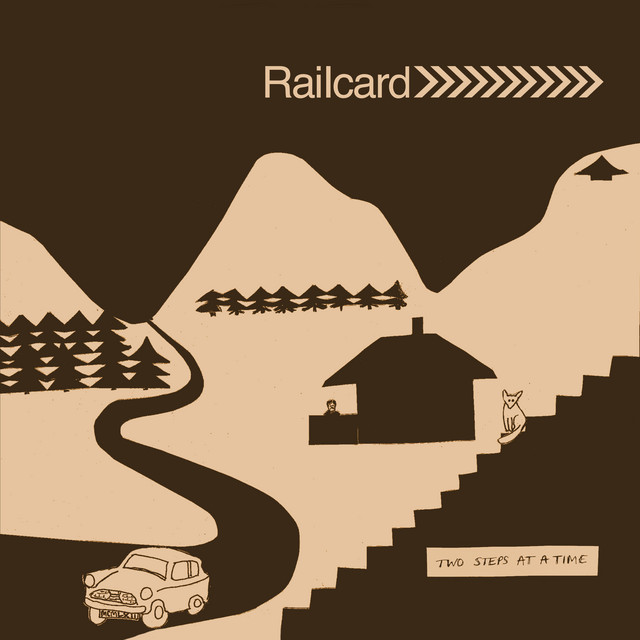
Railcard Two Steps At A Time
- Released
- 2026
- Label
- Skep Wax / Slumberland
Railcard | Two Steps At A Time [Skep Wax / Slumberland]
Indie Pop / Jangle Pop / Psychedelic Pop | 2026
Some musicians spend decades developing their individual identities before discovering just how naturally they can work together. Railcard arrived at that point remarkably quickly. Formed in 2025 by Rachel Love of Dolly Mixture, Ian Button and Peter Momtchiloff of Heavenly, and completed by trumpeter and keyboard player Allison Thomson, the London quartet has already developed an impressive body of material. Released on September 18, 2026, their first proper studio album, "Two Steps At A Time", contains twelve songs that explore the enduring appeal of melodic guitar pop, inventive arrangements and affectionate lyrical eccentricity. At just under 39 minutes, it is an unusually concentrated collection of ideas from musicians whose shared musical experience gives them plenty to work with.
There is an appealing lack of self-consciousness about Railcard's approach. The performances are relaxed without sacrificing precision, and the arrangements frequently reveal considerable sophistication beneath their straightforward melodies. Love's clear, expressive singing works particularly well alongside Button's conversational vocal delivery. Momtchiloff contributes bass lines that regularly establish the songs' rhythmic character, while Thomson's trumpet and keyboards introduce melodic counterpoints that give the recordings much of their individuality. Allan Crockford's mixing preserves the instruments' natural character, with generous reverberation and enough separation to make the interaction between the musicians easy to appreciate.
The opening title track, "Two Steps At A Time", introduces these qualities with considerable charm. Love's understated vocal performance and direct guitar playing establish a relaxed melodic framework, while Button's supporting voice and the lightly accented drums add movement. Brief passages of whistling provide an unexpected melodic detail without interrupting the song's easy progression. The arrangement develops naturally, allowing each instrumental contribution to register within its compact two-and-a-half-minute running time. There is something particularly satisfying about its economy. The band establishes a memorable melody, develops it through subtle changes in vocal arrangement and finishes before the central idea loses its appeal.
"1962 Forever" brings the group's unusual origins directly into the songwriting. The founding musicians discovered that they were born within weeks of one another in 1962, and the song celebrates that coincidence with playful sincerity. Its vocal harmonies and melodic phrasing capture the group's pleasure in making music together. The following "Hillman Minx", one of two compositions credited to Momtchiloff, changes the tempo and intensity. An insistent bass figure supports distorted guitar chords and energetic drumming, while trumpet phrases add melodic detail. Its concise structure and rhythmic urgency provide one of the album's most immediately engaging performances.
The fourth track, "Flannelette", develops the band's gentler musical instincts into one of the record's finest arrangements. Organ chords support expansive vocal harmonies, with Thomson's trumpet contributing a distinct recurring melodic phrase. The bass remains prominent, giving the song a firm rhythmic foundation beneath its sustained keyboard tones and flowing vocal lines. Love's performance is particularly affecting here, demonstrating how much expression she can communicate through restrained phrasing. The arrangement progresses with patience, allowing its individual elements to become increasingly prominent without overwhelming the central melody. It is a beautifully considered piece of songwriting, supported by production that preserves its intimacy.
"Foxy" continues the album's interest in delicate vocal expression and unusual melodic turns. Its restrained arrangement and slightly mysterious tone introduce a welcome change in emotional emphasis. "I'm A Disaster" immediately follows with a much more animated performance. The interplay between the singers carries an engaging mixture of humor and frustration, while the forceful rhythm section gives the song a distinctly rougher character. Railcard clearly enjoy exploring different degrees of intensity, although their instinct for polished melodic resolution occasionally makes individual songs feel a little too comfortable. The album is most exciting when the arrangements retain some unpredictability.
Momtchiloff's second contribution, "Paper Thin", provides another worthwhile change in perspective. Its short running time and fragile melodic construction contrast with the album's more rhythmically assertive material. The restrained performance allows a sense of uncertainty to remain within the music. It also demonstrates the importance of having several songwriters involved. Momtchiloff's contributions introduce different melodic instincts while remaining consistent with the quartet's collective approach.
"Unstable Neighbour" is among the album's most adventurous recordings. Running for just over four minutes, it develops an insistent rhythmic pulse around repeated vocal phrases and persistent instrumental patterns. The repetition becomes central to the arrangement, establishing a hypnotic momentum that continues throughout the performance. Love's vocal delivery remains controlled while the guitars and trumpet introduce changes in tone and emphasis. Thomson's playing is particularly effective, adding brief melodic interventions that interrupt the regularity of the underlying rhythm. The extended structure gives the musicians sufficient room to explore their ideas without compromising the song's directness. It is one of the clearest examples of Railcard's ability to combine accessible songwriting with genuine rhythmic experimentation.
The remaining songs demonstrate the group's considerable range within its chosen musical vocabulary. "Runaround" introduces energetic vocal interplay and short trumpet passages that draw on freer jazz phrasing. These interruptions give the arrangement an appealing rhythmic unpredictability. "When You Say You Love Me Something's Wrong" turns toward melodic melancholy, with its gently expressive vocal performance emphasizing the emotional uncertainty suggested by the title. David Lovell contributes guitar to the recording, adding another element to the band's carefully balanced instrumentation.
"Snow Blind" is particularly impressive in its harmonic development. Its changing chord sequence supports a memorable refrain, while the arrangement gradually introduces greater emotional complexity. The vocal harmonies remain prominent, and the unexpected synthesizer tones toward the conclusion give the song an unusual final passage. At four minutes and twenty-four seconds, it is the album's longest track, and the additional space is used effectively. The closing "Sunday Sun" returns to a gentler musical approach, ending the record with an intimate vocal performance and carefully controlled arrangement. Its understated conclusion suits an album whose strongest emotional moments often emerge through subtle changes in melody and harmony.
What ultimately distinguishes "Two Steps At A Time" is the ease with which its musicians combine their individual contributions. Love and Button's vocal partnership provides the songs with warmth and personality, Momtchiloff's bass playing supplies an essential rhythmic presence, and Thomson's trumpet frequently introduces the album's most memorable instrumental passages. Crockford's sympathetic mixing gives the recordings a cohesive character while preserving the different approaches taken across the twelve tracks.
The record's weaknesses are relatively minor. A few melodies settle into familiar patterns, and certain arrangements could benefit from greater dynamic contrast. There are moments when the group's affection for gentle pop conventions limits the possibilities suggested by its more adventurous instrumental ideas. Nevertheless, the songwriting remains consistently engaging, with sufficient variation in tempo, vocal arrangement and harmonic structure to sustain interest throughout the album.
Railcard have created a debut that rewards attention to the details of its performances. The band understands the effectiveness of a simple melodic phrase, but its strongest songs also demonstrate an appetite for rhythmic experimentation and imaginative instrumentation. "Flannelette", "Unstable Neighbour", "Hillman Minx" and "Snow Blind" reveal different aspects of an unusually compatible group of musicians. Their enthusiasm is evident throughout, supported by decades of musical experience and an impressive capacity for writing concise, distinctive songs. "Two Steps At A Time" is a thoroughly enjoyable album whose musical intelligence becomes increasingly apparent with repeated listening.
Rating: [4/5]